
Mortality Research Published: Modelling Socio-economic Differences in Australia
Our Actuaries Institute research paper on socio-economic mortality modelling is now available, alongside an interactive Australian Longevity Explorer.

I am an Actuarial Analyst and Computer Scientist based in Canberra. I recently graduated from the Australian National University with First Class Honours in Computing, alongside degrees in Actuarial Studies and Science (Computing major and Mathematics minor)**.
My greatest assets are my drive and dedication. I look forward to sharing my professional journey here on this website!
My expertise lies at the intersection of machine learning and actuarial science. I am dedicated to applying advanced computing techniques to enhance data interpretation and risk assessment. My core philosophy is to move beyond "black box" modeling, ensuring that complex algorithms remain interpretable, transparent, and ethically sound for stakeholders.
While many focus solely on technical aptitude, I believe my greatest asset is my unwavering drive and dedication. I pursued a multidisciplinary double degree to develop a niche skill set that bridges the gap between raw data science and rigorous actuarial standards.
I have a proven track record of managing high-pressure, complex workloads. During my final two years of university, I successfully balanced a role at the Australian Government Actuary while overloading with multiple Part 2 and 3 courses for the Actuaries Institute. As a result, I completed all but one actuarial exam required for Fellowship prior to graduation.
I am a proactive leader who identifies gaps and creates solutions. Recognizing a need for better community representation, I initiated and co-founded the first Sri Lankan Society at ANU. This role required high-level organization, task management, and the ability to coordinate large-scale events and programs from the ground up.
I am deeply committed to the idea of "lifting as you climb." As a tutor and mentor, I took the initiative to redesign course content and develop original assignments to improve the student experience (examples of which can be found in my Projects section).
My commitment to impactful work also drove my Honours research, which introduced novel health-based variables into mortality projections. This research aims to refine mortality predictions to ensure more accurate and sustainable retirement pricing for Australians.
Bachelor of Computing (Honours)
Australian National University
Associateship (AIAA)
Actuaries Institute Australia
Bachelor of Actuarial Studies
Australian National University
Bachelor of Science
Australian National University
Our Actuaries Institute research paper on socio-economic mortality modelling is now available, alongside an interactive Australian Longevity Explorer.

I'm excited to announce my selection as a mentee in the 2024 Actuaries Institute Mentoring Program.

A reflection on my university journey, the scenic route to three degrees, and the lessons learned along the way.

I'll be presenting my work on mortality modelling at the All Actuaries Summit.
Australian National University | Graduated: Dec 2025
Grade: First Class Honours (Thesis: 92%)
Thesis: "Rethinking Mortality Using a State-Based Dynamic Probabilistic Model Leveraging National-Scale Health Data"
Relevant Coursework: Statistical Machine Learning, Research Methods, Document Analysis, Computer Vision.
Australian National University | Graduated: Dec 2024
GPA: Science (6.63/7.0) | Actuarial (6.06/7.0)
Major: Computer Science | Minor: Mathematics
Key Coursework: Algorithms, Number Theory & Cryptography, Actuarial Data Analytics, Survival Modelling, Life Contingencies.
Actuaries Institute Australia
My Honours research, “Rethinking Mortality Using a State-Based Dynamic Probabilistic Model,” tackles one of the most complex financial and social challenges in Australia: predicting how long a population will live when health and lifestyle are constantly shifting.
Traditional mortality models are “static”—they rely on broad population averages that fail to account for an individual’s evolving health. This leads to massive systemic risks that affect every Australian. My research is novel because it moves away from these averages, creating a dynamic, state-based model that adapts as an individual’s health status changes.
The precision of this model has direct consequences for the Australian economy:
Retirement Product Pricing: For the private sector, accurate mortality forecasting is the “engine” behind Annuities and Pension products. If models are inaccurate, these products become either too expensive for the average person or financially unstable for the provider. My research enables more equitable pricing, ensuring retirees get the most out of their hard-earned savings.
Sustainability of Subsidies: On a federal level, the Age Pension and various Retirement Subsidies represent one of the government’s largest expenditures. Even a slight miscalculation in mortality trends can lead to billions of dollars in “hidden” liabilities. In coorporating health variables to mortality predictions provides a more robust framework for the government to manage these subsidies, ensuring the system remains solvent for future generations.
The Social Impact: Longevity vs. Quality of Life At its heart, this is about dignity in aging. The social impact of this research is profound: it helps solve the “fear of outliving your money.” By providing a clearer planning horizon, we can reduce the anxiety of retirees, allowing them to spend their savings with confidence rather than living in unnecessary frugality due to statistical uncertainty.
What makes this research truly unique is the data behind it. I was granted highly restricted access to the Personal-Level Integrated Data Asset (PLIDA).
Extreme Difficulty of Access: PLIDA is a massive, national-scale dataset that links health, census, and government records. Gaining access requires rigorous ethical clearance and high-level technical trust.
A “First-of-its-Kind” View: This is Australias first attempt to incorporate health information for mortality on a national scale,. With this research I was able to observe real-world health transitions that have never been factored into traditional actuarial models.

A health-informed framework using PLIDA data and Markov-chain modelling to improve mortality prediction accuracy for Australian retirees.


A presentation on leveraging national-scale health data (PLIDA) to improve actuarial forecasting.

A panel discussion for first-year actuarial students covering degree navigation, career insights, and tips for success.
A presentation on leveraging national-scale health data (PLIDA) to improve actuarial forecasting.
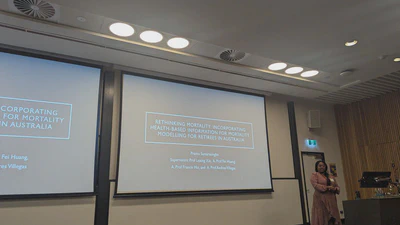
Discussing the application of probabilistic machine learning models to the PLIDA dataset.
A short course focusing on evaluating climate risks and sustainable strategies.
Practical training in modern data science and artificial intelligence techniques tailored for actuarial workflows.